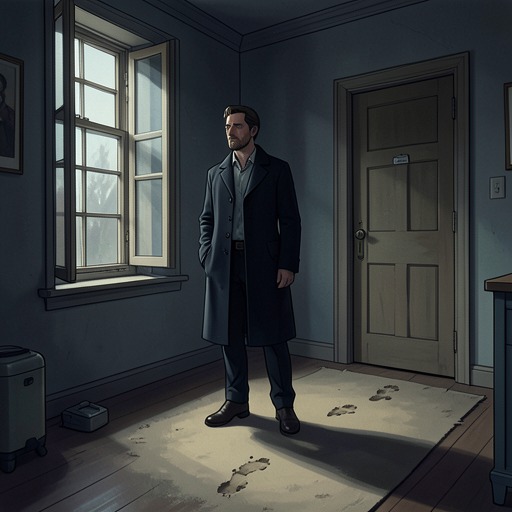
the goose quill
The Murder of Roger AckroydThe goose quill is an empty tube used to carry and sniff heroin, discovered in the summerhouse at Fernly Park. Its evidentiary force lies not simply in identifying a drug user, but in making the summerhouse legible as a rendezvous rather than a shortcut: Hercule Poirot uses it to connect an American-accented stranger with the house and, when set against the timing of other evidence, to reconstruct two separate meetings there on the night of Roger Ackroyd’s murder.
Appearance and Function
The quill first appears as one of two clues found when Poirot searches the summerhouse; the other is a scrap of cambric. Dr. James Sheppard examines the little object and recalls having read about the practice. Poirot confirms that it was used for heroin, known as “snow,” which drug-takers carried in such a tube and sniffed through the nose. Sheppard supplies the drug’s formal name, diamorphine hydrochloride, while Poirot draws a geographic inference: this method was common across the Atlantic, making it another indication that the stranger came from Canada or the United States.
The quill is not described as a conventional weapon or a purpose-made instrument. It is a small, portable container whose emptiness matters: it bears evidence of a habit and of a person’s presence, even though the drug itself is gone. When Poirot later shows it to Charles Kent, he explicitly points out that it is empty and says Kent dropped it in the summerhouse that night. The discarded object thus preserves a trace where its user has left none of the substance it once carried.
Discovery in the Summerhouse
The clue’s meaning depends on where it is found. Poirot explains that Inspector Raglan had treated the path as a shortcut to the house, but the summerhouse suggested a different use: someone might take the same path to meet another person there. Because the stranger had apparently used neither the front nor the back door, Poirot considered whether someone from inside the house had gone out to meet him. The summerhouse offered a convenient place for such an encounter.
Searching it, Poirot found both the cambric scrap and the quill. The two objects prompted different lines of inquiry. The starched cambric suggested a maid’s apron; the quill indicated a drug-taker. In the final reconstruction, Poirot explains that the latter clue, combined with the stranger’s American accent, initially supported the suspicion that the stranger had gone there to meet Ursula Bourne. The inference was plausible, but it did not yet explain the schedule.
Two Meetings and a Problem of Time
The quill’s first interpretation runs into a chronological obstacle. Ursula Bourne’s account placed her in her bedroom from half past nine until ten, so she could not have reached the summerhouse before half past nine. Yet the stranger must have arrived by a few minutes past nine. Poirot could suppose the stranger waited, but the timing also opened the alternative that there had been two meetings in the summerhouse that night.
Other evidence gave that alternative shape. Miss Russell had visited Dr. Sheppard that morning and shown interest in remedies for drug addiction. Read together with the quill, that circumstance led Poirot to infer that the stranger had come to meet the housekeeper, not Ursula. The quill therefore does more than point to a single visitor: its apparent connection to an American drug user becomes part of a distinction between an early meeting and a later rendezvous. Separately, the cambric, a wedding ring bearing “From R.” and a date, and reports of Ralph Paton on the path helped Poirot reconstruct Ursula’s connection to the later meeting.
Charles Kent and the Clue’s Return
Poirot eventually puts the quill to direct use in questioning Charles Kent. He tells Kent that he was at the house that night, then takes the object from his pocket and identifies it as the goose quill found in the summerhouse. On seeing it, Kent half reaches for it. Poirot remarks that it is empty and says it lay where Kent dropped it. Kent responds uncertainly, then challenges Poirot with the reported time of the murder, insisting that the old man had been killed between a quarter to ten and ten o’clock. Poirot agrees that this was the reported interval.
That exchange turns the quill from an interpreted trace into an instrument of confrontation. Kent’s reaction does not, by itself, establish the whole sequence of events, but Poirot’s identification ties him to the summerhouse and brings the drug clue into the questioning of the stranger. In the final account, Poirot restates the chain for those gathered at Fernly Park: the quill suggested a drug-taker; the American accent supported the inference of an Atlantic visitor; and the mismatched times forced him to consider separate meetings rather than one simple encounter.
Evidentiary and Narrative Significance
The goose quill’s importance comes from the work it performs across the investigation. First, its physical location changes the interpretation of the path and summerhouse. Then its use points toward a particular kind of visitor and a possible origin. Finally, its timing fails to fit the initial theory about Ursula, forcing Poirot to revise the reconstruction. The clue is valuable precisely because it does not settle the case on its own: it gains meaning through its conjunction with the accent, the housekeeper’s interest in drug cures, the cambric, the wedding ring, and the reported movements along the path.
Its return in Poirot’s pocket also gives the clue a compact dramatic arc. At first it is an object Dr. Sheppard can only recognize through remembered medical reading; later it is a physical token shown to Kent; at the final gathering it becomes part of an explanation that separates two meetings concealed within the same small building. The quill remains empty, but the investigation fills that emptiness with a carefully revised account of who came to the summerhouse, why the route mattered, and how one discarded trace could expose the limits of the first theory.